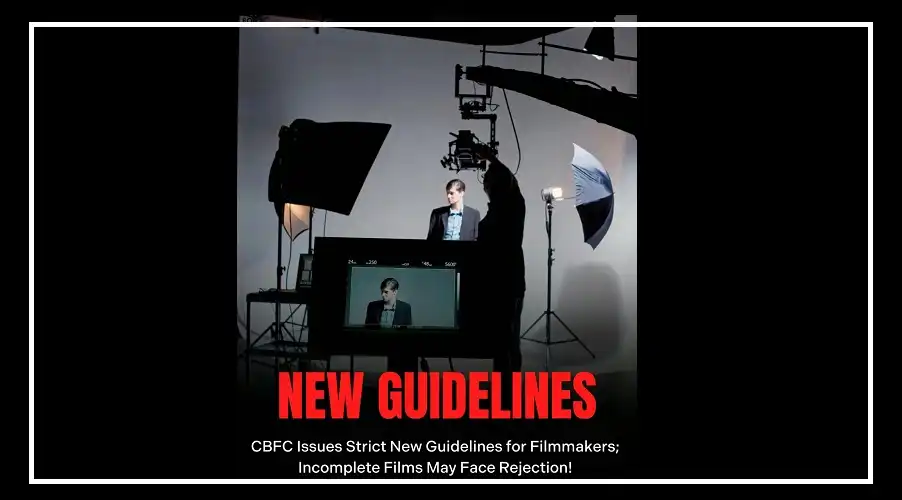

CBFC new rules for film certification will require filmmakers and production houses to submit complete and final versions of their movies instead of unfinished prints.
The Central Board of Film Certification has also clarified that announced release dates will not help films receive faster certification.
The five-point advisory was issued on October 26, 2026, and signed by CBFC Chief Executive Officer Rajendra Singh.
It applies to applicants seeking certification under the Cinematograph Act, 1952, and the Cinematograph (Certification) Rules, 2024.
The new instructions are intended to clarify submission requirements and prevent incomplete applications from delaying the certification process.
Five Key Changes in CBFC Film Certification Rules
The CBFC advisory outlines five important requirements for filmmakers.
First, films must be submitted in their complete and final form, including titles, credits, subtitles, disclaimers, background score, music and final sound mix.
Second, film titles mentioned in certification applications will not automatically be treated as approved. The Examining or Revising Committee can review and modify titles under the applicable guidelines.
Third, incomplete or work-in-progress film prints may not be accepted as compliant submissions.
Temporary graphics, placeholder content, unfinished scores and missing accessibility features could result in delays, applications being returned or rejection.
Fourth, announced theatrical release dates and promotional launch dates will not influence the certification schedule. Films will be examined according to the prescribed procedure and timelines.
Fifth, producers have been advised to submit their applications sufficiently early, allowing time for examination, committee review and any changes directed by the Board.
Incomplete Films May Face Delays or Rejection
One of the most significant changes concerns the condition of films submitted for examination.
The CBFC has made it clear that producers cannot submit unfinished versions while expecting the remaining work to be completed during the certification process.
The final print must include all relevant technical and creative elements. These include final graphics, titles, credits, subtitles, disclaimers, censor certificate slates, background score, music and sound mix.
Accessibility features intended for theatrical exhibition must also be included wherever applicable. These may include closed captions, subtitles for hearing-impaired viewers and audio descriptions.
The Board has warned that submissions containing temporary graphics, scratch scores or missing accessibility elements may be treated as non-compliant. Such applications could be delayed, returned or rejected.
The advisory also reiterates that only the version duly certified by the CBFC can be exhibited in theatres.
Film Titles Can Be Changed Even After Submission
The CBFC has clarified that a film title mentioned in a certification application is not automatically final or approved. This applies to titles used for films, trailers, teasers and promotional material.
The Examining or Revising Committee can examine the proposed title and seek modifications under the relevant provisions of the Cinematograph Act and Certification Rules.
Producers have therefore been advised not to treat a publicly announced title as permanently approved before certification.
A title may still be reviewed even after it has been submitted as part of the application.
This clarification means production houses may need to remain prepared for title-related changes during the certification process.
Announced Release Dates Will Not Speed Up Certification
The Board has also addressed requests for faster certification linked to fixed theatrical release dates.
According to the advisory, a film’s announced release date, trailer launch or teaser launch will not be considered a reason to expedite its application.
Certification will follow the procedures and timelines prescribed under the existing rules.
The Board has also pointed out that examination and review may involve cuts, revisions or other modifications, which require sufficient time.
An application will be treated as received only after all required documents have been submitted and the prescribed formalities have been completed.
Its position in the examination queue will be determined by the date on which it is considered complete.
This means submitting an unfinished film early will not necessarily secure an earlier place in the certification process.
Why Filmmakers Need to Plan Their Releases Earlier
The new advisory makes advance planning important for producers, directors and production houses.
They will need to complete the film, prepare the required documents and submit the certification application with enough time before the intended release.
Filmmakers should also account for the possibility of committee review and changes directed by the CBFC. A release date announced publicly cannot override the prescribed certification process.
The advisory comes after the government reconstituted the CBFC with an 18-member board in September 2026.
The latest instructions provide clearer expectations for applicants seeking certification under the existing legal framework.
For the film industry, the key message is that certification planning must be part of the production and release schedule rather than a last-minute step.