
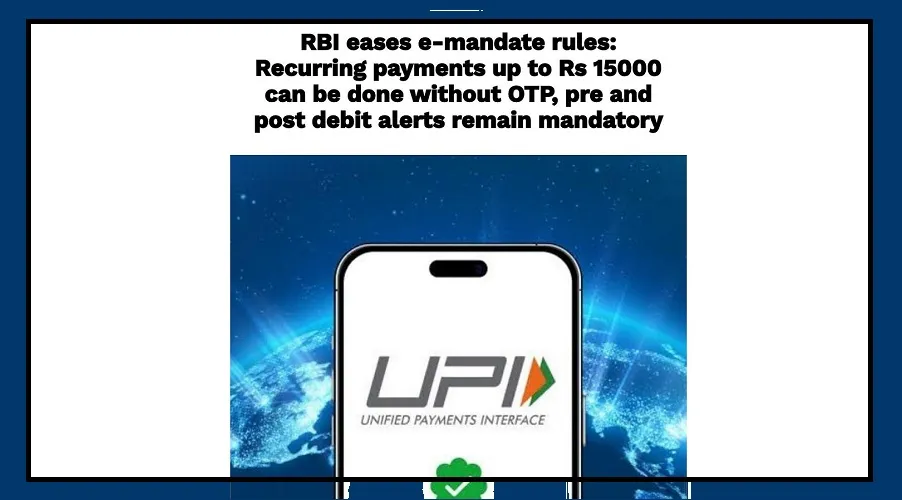

The Reserve Bank of India (RBI) has introduced new rules to make digital payments safer and more transparent. These guidelines, known as the Digital Payment E-Mandate Framework 2026, are now in effect.
The focus is on improving security for recurring payments by making Additional Factor Authentication (AFA), like OTP, more important.
What is an E-Mandate?
An e-mandate is a simple feature that lets you approve payments in advance.
This means money gets automatically deducted from your account at a fixed time. The amount can be fixed, like a subscription fee, or variable, like an electricity bill.
You can also set a maximum limit for variable payments to stay in control.
When is OTP Required?
The new rules clearly define when OTP (AFA) is needed.
For payments up to Rs 15,000, you don’t need to enter an OTP every time.
But if the amount crosses Rs 15,000, OTP becomes mandatory.
There is some relief for essential payments. For insurance, mutual funds, and credit card bills, transactions up to Rs 1 lakh can go through without OTP.
Alerts and Customer Control
Customers will now get better control and transparency.
You will receive a notification at least 24 hours before every auto-debit. This message will include details like the merchant’s name, payment amount, and date.
You can choose to receive these alerts through SMS or email, depending on your preference.
Rules for Changes and Cancellation
If you want to modify or stop an e-mandate, security checks will apply.
OTP verification is required to make any changes or to cancel a mandate. You also have the option to opt out of any upcoming transaction, but that process will also need OTP confirmation.
What About the First Transaction?
The first transaction under an e-mandate will always require OTP.
If you make a payment while setting up the mandate, both steps can be completed together in one go.
When Notifications Are Not Required
There are a few exceptions to the notification rule.
For auto-recharge services like FASTag or the National Common Mobility Card (NCMC), you will not receive pre-transaction alerts.