
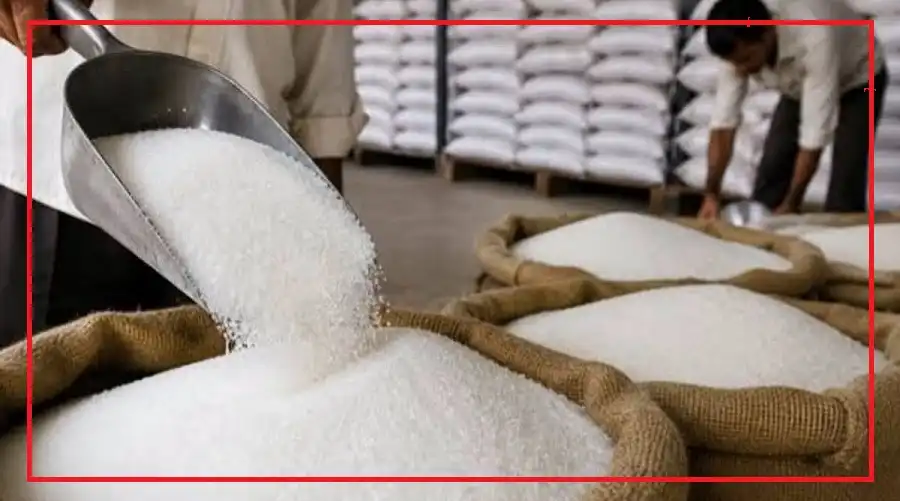

Sugar Mill Rules have become stricter after the Central Government introduced new guidelines requiring sugar mills to follow monthly sales quotas and stockholding limits more carefully.
Mills that fail to utilise at least 90% of their allocated monthly sales quota or repeatedly violate stock limits could face reduced allocations and lose access to export quotas and government incentives.
The Department of Food and Public Distribution (DFPD) issued the revised instructions on November 13, 2026.
The measures are aimed at improving compliance, preventing excessive stock accumulation and ensuring the smooth availability of sugar in the domestic market.
Sugar Mill Rules: What Has Changed?
Under the revised guidelines, sugar mills must comply with their allocated monthly domestic sales quotas and prescribed stockholding limits.
The government has clarified that mills selling or dispatching sugar beyond their allotted monthly quota will face adjustments in their future allocations.
The excess quantity will be deducted from the following month’s quota.
If the entire excess cannot be recovered through the next month’s allocation, the remaining adjustment will be carried forward until the full quantity has been recovered.
The government will also conduct physical stock inspections through joint teams of Central and state government officials.
Mills found violating the rules may face action under the Essential Commodities Act, 1955.
Mills Must Utilise at Least 90% of Monthly Quota
One of the important requirements is the minimum utilisation of the allocated sales quota.
Sugar mills must sell and dispatch at least 90% of their monthly quota.
If a mill sells or dispatches less than this limit without informing the department by the 20th of the month, its next month’s quota will be reduced according to the actual utilisation percentage.
For example, if a mill uses only 80% of its allocated quota without submitting the required information, its next month’s allocation may be restricted to the corresponding utilisation level.
This provision is intended to discourage mills from keeping allocated sugar stocks without supplying them to the market.
Third Violation Could Cost Mills Export Benefits
The government has introduced stricter penalties for mills that repeatedly violate stockholding restrictions.
If a sugar mill or group breaches the prescribed stockholding limits more than twice within a one-year period, it can become ineligible for benefits under DFPD schemes.
These benefits include export quotas and related government incentives. The restriction will apply from the month of the third violation, subject to the applicable scheme provisions.
The department will calculate the one-year period backwards from the date on which the relevant scheme is notified.
For example, if an export quota scheme is announced on December 1, 2026, violations recorded between December 1, 2025, and November 30, 2026, will be considered.
The government may also advise state authorities to take action against repeat offenders, including refusing crushing licences or reducing the sugarcane area attached to a mill.
GST Reporting Rules Also Become Stricter
The revised guidelines also place greater emphasis on accurate sales reporting through GST returns.
Sugar mills must provide correct sales information with Harmonised System of Nomenclature (HSN) code-wise details in their GST filings.
If a mill fails to submit the required information correctly, its sales quota may be suspended until the missing or incorrect details are corrected and verified by the department.
The government will compare information submitted through the National Single Window System with sales data shared by the Goods and Services Tax Network (GSTN).
This monitoring system is intended to identify differences between reported sugar sales, actual dispatches and available stock.
When Can Sugar Mills Lose Additional Quota?
The new guidelines also specify conditions under which mills may become ineligible for additional sugar allocations.
Requests for additional quota may not be considered if mills have pending quota adjustments, keep sold sugar in their premises for more than seven days after invoicing, or sell sugar to dealers who are not registered on the DFPD stock monitoring portal.
Additionally, mills storing sugar sold to bulk consumers or dealers in their own warehouses under lease arrangements must inform the department within three days.
They must provide details of the quantity stored and the storage period, along with a copy of the lease agreement.
If these details are not submitted, the department may treat the stored sugar as the mill’s own stock during physical verification.
Why Has the Government Tightened Sugar Mill Rules?
The government’s main objective is to ensure that sugar moves smoothly from manufacturing units into the domestic market.
Stock accumulation, sales beyond allocated quotas and inaccurate reporting can affect the distribution of sugar and make it difficult for authorities to monitor market availability.
The revised guidelines also support the government’s efforts to prevent hoarding and maintain a balance between consumer interests and the sugar industry’s requirements.
Sugar mills play an important role in the supply chain because their sales and stock management can influence the availability of sugar for wholesalers, retailers and other buyers.
The stricter rules are also relevant for sugarcane farmers because regular sugar sales help mills generate revenue needed to meet their payment obligations.
For sugar producers, the message is clear: following sales quotas, maintaining accurate records and reporting stock movements are becoming increasingly important.
The revised guidelines make repeated violations financially costly, particularly for mills that depend on government allocations and export-related benefits.