

New PUC certificate rules 2026 bring relief to owners of newer private cars and bikes in India.
Under the revised government rules, BS-VI private vehicles up to six years old will require a Pollution Under Control (PUC) certificate renewal only once every three years instead of annually.
The Ministry of Road Transport and Highways (MoRTH) has notified the changes through the Central Motor Vehicles (Sixteenth Amendment) Rules, 2026.
The revised rules also specify different renewal periods for older vehicles and commercial transport vehicles based on their age and emission standards.
The changes aim to make pollution certificate compliance easier for newer vehicles while maintaining more frequent emission checks for older vehicles.
New PUC Certificate Rules 2026: Vehicle-Wise Validity
The revised rules introduce different PUC certificate validity periods depending on the vehicle’s emission standard and category.
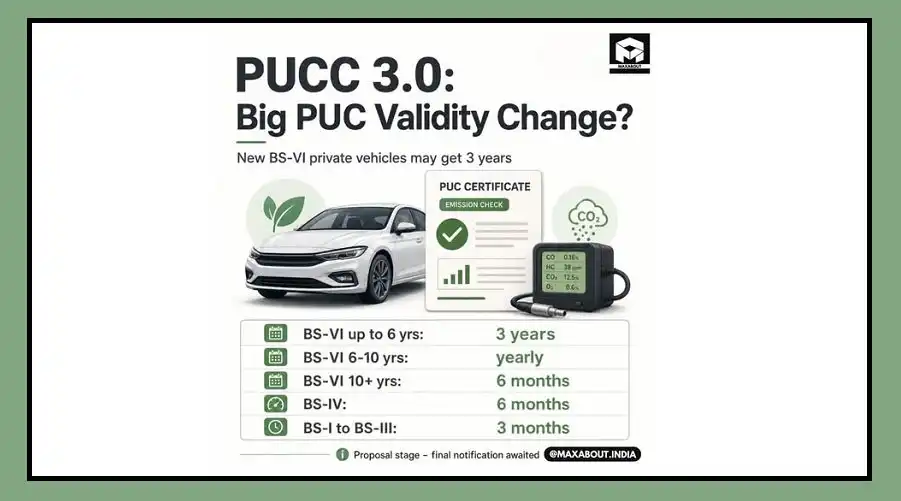
For private BS-VI vehicles, the new renewal schedule is:
Up to six years old: Once every three years.
More than six years but up to 10 years old: Once every year.
More than 10 years old: Once every six months.
This means owners of eligible newer private cars and motorcycles will no longer need to renew their PUC certificates every year.
However, the three-year validity benefit is not available to all vehicles. It applies specifically to non-transport vehicles complying with BS-VI emission standards.
PUC Rules for Older BS-IV and BS-III Vehicles
The government has retained shorter validity periods for vehicles complying with older emission standards.
Vehicles meeting BS-IV emission norms will continue to require PUC certificate renewal every six months.
For vehicles complying with BS-I, BS-II and BS-III emission standards, the certificate will remain valid for only three months.
Owners of these vehicles will therefore need to undergo pollution checks more frequently.
These provisions mean that the extended validity is primarily intended for newer BS-VI vehicles rather than older vehicles with comparatively outdated emission standards.
Commercial Vehicles Have Different PUC Renewal Rules
The revised rules also provide separate validity periods for BS-VI transport vehicles, including commercial vehicles.
BS-VI transport vehicles up to six years old will require PUC certificate renewal once every two years.
For transport vehicles that are more than six years old but not more than 10 years old, the renewal requirement will be once every year. Vehicles older than 10 years will need a fresh PUC certificate every six months.
Therefore, commercial vehicle owners will not receive the same three-year validity benefit available to newer private vehicles.
When Will the New PUC Rules Apply?
The revised provisions have been notified under the Central Motor Vehicles (Sixteenth Amendment) Rules, 2026, and came into force following publication in the Official Gazette on November 19, 2026.
An important point concerns existing PUC certificates. The revised validity schedule will apply to certificates already issued only when they undergo their first renewal after the new rules come into force.
The government has also clarified the timing of renewed certificates.
If a vehicle owner applies for renewal within the 10 days immediately preceding the existing certificate’s expiry, the renewed certificate will become effective from the expiry date.
In other cases where renewal is requested after the existing certificate has expired, the new certificate will become effective from the actual date of renewal.
What Vehicle Owners Should Remember
The New PUC Certificate Rules 2026 offer considerable convenience to owners of newer BS-VI private vehicles by reducing the frequency of certificate renewals.
However, vehicle owners should not assume that every new car or motorcycle automatically receives three years of validity.
The applicable period depends on the vehicle’s emission standard, age and whether it is registered as a transport or non-transport vehicle.
Drivers must continue to carry a valid PUC certificate and produce it when requested by authorised officials.
The revised rules make it important for vehicle owners to check their vehicle’s registration date and emission category before planning their next pollution certificate renewal.