
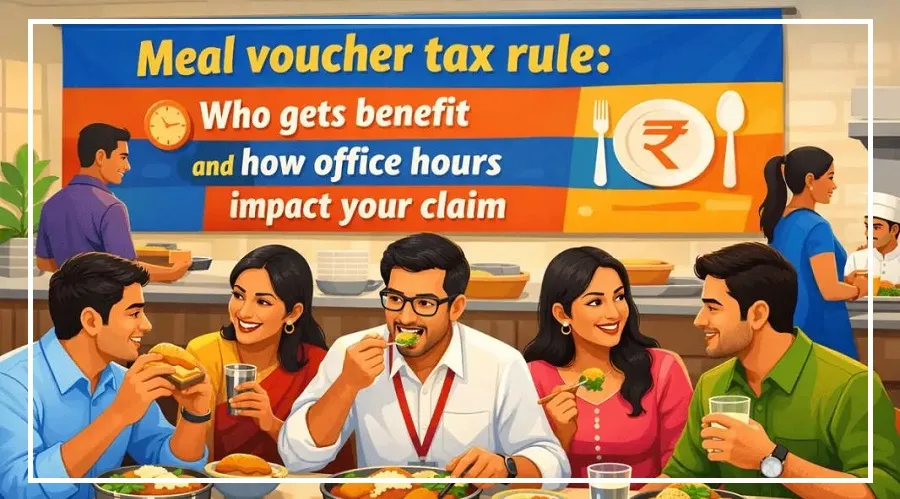

As the ITR filing season begins, many salaried employees are confused about one thing — how much tax exemption they can claim on meal vouchers.
Some companies are offering meal benefits of up to ₹200 per day, which makes people assume that the full amount is tax-free.
But that’s not completely true.
If you claim the wrong exemption while filing your ITR, you could end up paying extra tax later. So, it’s important to clearly understand the rules hat apply this year.
What Rule Applies for This Year?
For the financial year 2025-26 (assessment year 2026-27), the old rule is still in effect.
Under this rule, only ₹50 per meal is tax-free.
This means even if your company provides a ₹200 meal voucher, only ₹50 will be exempt from tax. The remaining ₹150 will be treated as part of your salary and will be taxable.
What Is the ₹200 Meal Voucher Rule?
The government has updated the rule and increased the tax-free limit to ₹200 per meal.
However, this new benefit will not apply this year.
It will come into effect from the next financial year, 2026-27. So, for now, you cannot claim exemption beyond ₹50 per meal.
Old vs New Tax Regime
There is another important point many people miss.
For FY 2025-26, the meal voucher exemption is available only if you choose the old tax regime. If you opt for the new tax regime, you will not get this benefit at all.
Once the new ₹200 rule becomes active, the exemption is expected to be available under both tax regimes.
Why You Don’t See It in Form 16
Many employees get confused because meal voucher details are not always shown clearly in Form 16.
This is because the amount is usually included under “Perquisites.”
To see the full details, you should check:
Form 12BA
Your salary slip
Company salary structure
Important Things to Remember
Keep proper records of your meal vouchers
Check your salary structure carefully
Verify details in Form 12BA
Report the correct taxable amount while filing ITR