

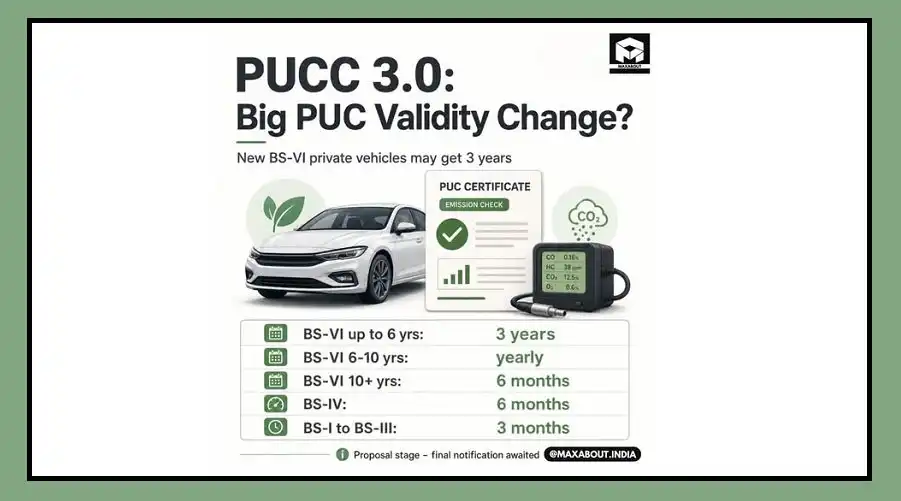

PUC Certificate Validity Rules have changed across India, bringing relief to owners of newer BS-VI private cars while making pollution testing more frequent for older vehicles.
Under the revised rules, private BS-VI vehicles up to six years old can now receive a Pollution Under Control (PUC) certificate valid for three years.
The Ministry of Road Transport and Highways (MoRTH) has introduced an age-based system that determines how frequently vehicles must undergo emission testing.
The changes consider both the vehicle’s Bharat Stage (BS) emission category and its age.
The Central Motor Vehicles (Sixteenth Amendment) Rules, 2026, amend Rule 115(7) of the Central Motor Vehicles Rules, 1989.
The revised provisions came into force following their publication in the Official Gazette on November 16, 2026.
PUC Certificate Validity Rules for Different Vehicles
The biggest benefit under the revised framework is for newer private BS-VI vehicles. Previously, BS-VI vehicles generally required annual PUC renewal, regardless of their age.
Under the new schedule, private BS-VI vehicles up to six years old will receive PUC certificates valid for three years. Vehicles older than six years but not exceeding 10 years must renew their certificates every year.
Private BS-VI vehicles older than 10 years will have to undergo pollution testing every six months.
Commercial and other transport BS-VI vehicles will follow a separate schedule.
Their certificate validity will be two years for vehicles up to six years old, one year for those older than six but not exceeding 10 years, and six months for vehicles older than 10 years.
The vehicle’s age will be calculated from its date of first registration.
Old BS-I to BS-IV Vehicles Face More Frequent Testing
The revised rules also introduce shorter PUC certificate validity periods for vehicles complying with older emission standards.
BS-I, BS-II and BS-III vehicles will now receive PUC certificates valid for only three months. This requirement applies regardless of whether the vehicle is privately or commercially registered.
BS-IV vehicles will have a certificate validity period of six months.
This means owners of older emission-category vehicles may need to visit authorised pollution testing centres more frequently than before.
The revised framework also establishes uniform validity periods under the central rules, replacing differences that previously existed in certain states and regions.
Complete New PUC Certificate Validity Schedule
The revised schedule under the 2026 amendment is as follows:
BS-I, BS-II and BS-III vehicles: Three months.
BS-IV vehicles: Six months.
Private BS-VI vehicles up to six years old: Three years.
Private BS-VI vehicles older than six years and up to 10 years: One year.
Private BS-VI vehicles older than 10 years: Six months.
Transport BS-VI vehicles up to six years old: Two years.
Transport BS-VI vehicles older than six years and up to 10 years: One year.
Transport BS-VI vehicles older than 10 years: Six months.
The revised validity periods are intended to reduce the compliance burden on owners of newer, cleaner vehicles while maintaining regular emission checks for older vehicles.
What Happens to Existing PUC Certificates?
Vehicle owners do not need to obtain a fresh PUC certificate immediately because of the new rules.
Certificates issued before the amendment came into force will remain valid until their existing expiry dates. The revised validity schedule will apply when the certificate is renewed for the first time after the amendment becomes effective.
For example, a private BS-VI car that is four years old and currently has a one-year PUC certificate will become eligible for a three-year certificate at its next renewal.
The amendment also clarifies how the validity of renewed certificates will be calculated.
If a vehicle owner applies for renewal within the 10 days preceding the existing certificate’s expiry, the renewed certificate will take effect from the previous certificate’s expiry date.
However, if the renewal is completed after the existing certificate has expired, the new certificate will become valid from the actual date of renewal.
What Vehicle Owners Should Do Now
Vehicle owners should check their vehicle’s BS emission category, date of first registration and current PUC certificate expiry date to understand which renewal schedule applies.
Those with newer private BS-VI cars may benefit from the longer three-year validity period, while owners of older vehicles should prepare for more frequent emission testing.
A valid PUC certificate remains a requirement under the motor vehicle regulations. Vehicle owners must obtain it from an authorised testing centre and produce it when requested by the designated authorities.
The revised rules do not eliminate pollution testing. Instead, they introduce different testing intervals according to vehicle age and emission standards, making it important for owners to check their eligibility before planning their next renewal.