
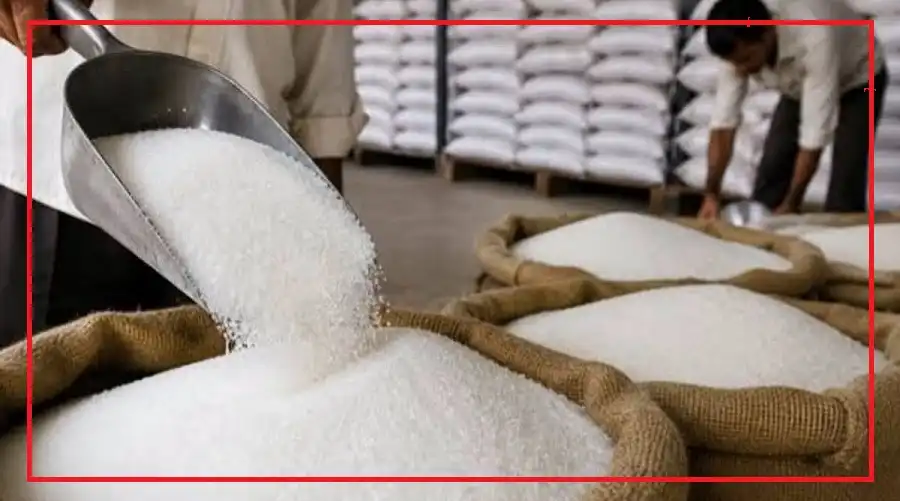

Raw sugar import deadline has been extended by the Central Government to March 31, 2027, giving importers three additional months to bring duty-free raw sugar into India.
The decision is aimed at improving domestic sugar availability amid concerns over production, supply and prices.
The government has extended the existing deadline from December 31, 2026, to March 31, 2027, under the Tariff Rate Quota (TRQ) scheme.
The overall duty-free import limit remains unchanged at 10 lakh metric tonnes.
The decision was notified by the Directorate General of Foreign Trade (DGFT) on November 25, 2026. All other conditions attached to the original import permission will continue to apply.
Why Has the Raw Sugar Import Deadline Been Extended?
The extension comes amid concerns about India’s sugar supply during the 2026-27 marketing season. Domestic sugar production is facing uncertainty due to unfavourable weather conditions and concerns over sugarcane yields in some major producing regions.
Maharashtra and Karnataka have experienced rainfall-related challenges, raising concerns about sugarcane production and recovery rates.
These factors have increased attention on the country’s sugar availability for the current season.
India is one of the world’s largest sugar producers and consumers. Domestic production, consumption, opening stocks and exports all influence the availability of sugar in the market.
The government had earlier permitted duty-free imports to increase domestic supplies and help manage price pressures.
Extending the import window gives eligible businesses additional time to arrange international purchases and bring raw sugar into the country.
How Much Raw Sugar Can India Import Duty-Free?
Under the existing arrangement, the government has permitted imports of 10 lakh metric tonnes of raw sugar through the Tariff Rate Quota mechanism.
The key details of the revised arrangement are:
Total permitted import quantity: 10 lakh metric tonnes.
Import duty: Zero for eligible imports under the quota.
Previous deadline: December 31, 2026.
New deadline: March 31, 2027.
Revised deadline announcement: November 25, 2026.
The quota has not been increased. Only the time available to complete the eligible imports has been extended by three months.
The import policy continues to classify raw sugar imports under the TRQ as free, subject to the specified conditions.
The revised notification covers raw sugar classified under Exim Code 170114 of Chapter 17 of the ITC (HS) 2022 import policy.
Who Can Import Raw Sugar Under the TRQ Scheme?
The duty-free import facility is not an unrestricted benefit available to every trader or business.
The scheme is intended for sugar millers and refiners that have functional facilities to convert imported raw sugar into white or refined sugar.
Eligible applicants must follow the allocation and documentation requirements prescribed by the DGFT.
Applications and related import formalities are handled through the DGFT Import Management System.
The government introduced this arrangement to make additional raw sugar available for domestic processing rather than allowing imports without the necessary refining infrastructure.
The latest extension provides more time for eligible importers who have received allocations to arrange shipments and complete the required procedures.
All existing conditions under the original August 2026 notification, as subsequently amended, will remain applicable.
Will the Decision Reduce Sugar Prices in India?
The extension is intended to support domestic availability, but it does not automatically guarantee an immediate reduction in retail sugar prices.
Sugar prices depend on several factors, including domestic production, mill supplies, consumption, transportation costs and international market rates.
Factory-gate sugar prices had already declined by around 4-5% following Diwali, as fresh supplies from Maharashtra and Uttar Pradesh increased.
The progress of crushing operations in these states is also expected to influence market availability in the coming weeks.
Maharashtra is India’s largest sugar-producing state, while Uttar Pradesh is another major contributor to domestic production.
The pace of sugarcane crushing and the quantity of sugar recovered from cane will remain important factors during the current season.
The additional import window could provide more flexibility to the industry if domestic supplies become tight.
However, the actual impact will depend on how much imported sugar reaches India and becomes available for processing.
What Happens Next?
The revised deadline gives the sugar industry until March 31, 2027, to utilise the eligible duty-free import quota.
The government will continue to monitor domestic production, sugar availability and market conditions during the ongoing crushing season.
For sugar millers and refiners, the extension provides additional time to arrange international supplies without the applicable import duty under the TRQ arrangement.
For consumers, the main objective is to maintain adequate domestic availability and manage potential supply pressures.
Whether the decision translates into more stable retail prices will depend on actual imports and the performance of India’s sugar production during the coming months.