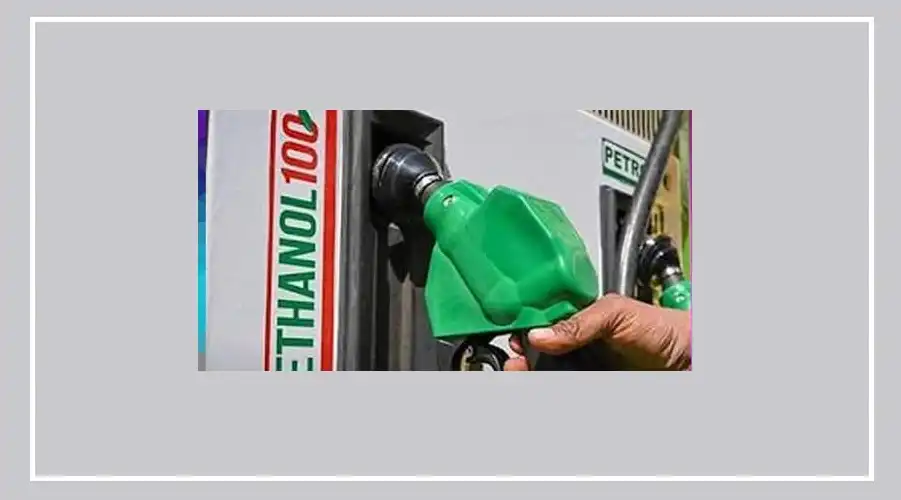

E100 Ethanol Fuel has received regulatory approval in India for vehicles specifically designed and certified to run on high-ethanol blends.
The Ministry of Road Transport and Highways has amended the Central Motor Vehicles Rules, 1989, to officially recognise E100 alongside E85, creating a framework for automakers to introduce compatible flex-fuel vehicles.
However, the decision does not mean that every petrol car in India can now use E100.
The government has clarified that only vehicles designed and certified by manufacturers as flex-fuel vehicles can run on these fuels.
What Is E100 Ethanol Fuel?
E100 refers to fuel containing nearly 100% ethanol. Ethanol is an alcohol-based fuel generally produced from agricultural feedstocks such as sugarcane and other biomass materials.
The number following the letter E indicates the percentage of ethanol in the fuel. For example, E20 contains 20% ethanol and 80% petrol, while E85 contains up to 85% ethanol.
Unlike conventional petrol vehicles, flex-fuel vehicles are engineered to operate using different proportions of petrol and ethanol.
Depending on the manufacturer’s design and certification, these vehicles can use fuel blends ranging from conventional petrol to higher ethanol concentrations, including E100.
Their fuel-system components and engine management systems are designed to handle different ethanol levels and adjust engine operation according to the fuel composition.
Can Existing Petrol Cars Use E100 Fuel?
No. Ordinary petrol cars cannot automatically use E100, even if they are compatible with E20 petrol.
The Ministry of Road Transport and Highways has made it clear that E85 and E100 are intended exclusively for vehicles specifically designed and certified for these fuels.
A vehicle’s compatibility with E10 or E20 does not establish that it can safely run on higher ethanol blends.
High ethanol concentrations require specially designed fuel-system components, including compatible seals, fuel lines and injectors.
The engine management system must also be capable of adjusting to the characteristics of the fuel.
The government has clarified that the new rules do not require existing vehicle owners to switch to E100 or modify their cars.
Motorists should check the fuel compatibility sticker on their vehicle and follow the manufacturer’s instructions in the owner’s manual.
What Changes Has the Government Made?
The Ministry of Road Transport and Highways has amended the Central Motor Vehicles Rules, 1989, to include E100 alongside E85 in the relevant emission certification and testing provisions.
The notification creates a regulatory framework for manufacturers to develop and certify vehicles capable of using higher ethanol blends.
Vehicles approved for these fuels must meet the applicable emission and safety requirements for their category.
The amendment also increases the relevant gross vehicle weight threshold for petrol vehicles from 3,000 kg to 3,500 kg.
The changes provide greater clarity for manufacturers working on flex-fuel technology and establish the regulatory provisions needed for vehicles designed to use E100.
Why Is India Promoting E100 Ethanol Fuel?
India’s move towards higher ethanol usage is part of its broader effort to reduce dependence on imported crude oil and encourage domestic fuel production.
Ethanol can be produced from agricultural materials, including sugarcane-based feedstocks.
Greater demand for domestically produced ethanol could support the biofuel industry and create additional opportunities across the agricultural supply chain.
The government also expects suitably designed vehicles using ethanol blends to help reduce certain exhaust pollutants and greenhouse gas emissions.
However, the overall environmental impact depends on the feedstock and the process used to produce ethanol.
Ethanol also has a lower energy content per litre than petrol.
This can affect fuel efficiency and driving range, depending on the vehicle and the fuel blend being used.
Will E100 Be Available at Petrol Pumps Across India?
The regulatory approval does not mean that E100 will immediately become available at every petrol pump.
The notification establishes the rules for compatible vehicles but does not announce a nationwide retail rollout date for the fuel.
Wider adoption will depend on fuel production, distribution arrangements and the infrastructure required to store and dispense higher ethanol blends.
Automakers will also need to ensure that their vehicles meet the required certification standards before they can be sold for E100 use.
For now, the most important point for car owners is that E100 approval applies only to compatible, certified flex-fuel vehicles.
Owners of regular petrol cars, including E20-compatible models, should continue using only the fuel recommended by their vehicle manufacturers.